The best time to visit Oman: October to April, and the summer told honestly
Updated September 25, 2026 · 7 min read
The short answer is October to April, and you will find it on every page about Oman. It is also true. The useful part is not the answer but the edges of it: which month at each end is actually worth booking, what changes on a single calendar date, and what the summer is really like for the people who come anyway.
Here is the coast, from the World Meteorological Organization’s normals for Muscat for 1991 to 2020. These are averages of daily figures, not records.
| Month | Average high | Average low | Rain |
|---|---|---|---|
| January | 25.1 °C | 16.7 °C | 14.3 mm |
| February | 26.3 °C | 17.8 °C | 6.5 mm |
| March | 29.4 °C | 20.3 °C | 11.5 mm |
| April | 34.6 °C | 24.7 °C | 11.4 mm |
| May | 39.5 °C | 29.1 °C | 2.5 mm |
| June | 39.4 °C | 30.4 °C | 7.0 mm |
| July | 37.3 °C | 30.0 °C | 1.7 mm |
| August | 35.9 °C | 28.4 °C | 0.7 mm |
| September | 35.5 °C | 27.1 °C | 0.1 mm |
| October | 34.6 °C | 24.7 °C | 0.9 mm |
| November | 29.9 °C | 21.0 °C | 6.9 mm |
| December | 26.6 °C | 17.9 °C | 9.8 mm |
The hottest month is not July
Look down the first column. The peak is May, at 39.5 °C, with June a tenth of a degree behind it. July is two degrees cooler than May and August is three and a half cooler.
And yet everyone who has spent an August in Muscat will tell you August is worse, and they are right. The reason is in a column that is not in the table: humidity. It bottoms out around 42 per cent in May and peaks near 67 per cent in August. A dry 39 °C in May is brutal in the sun and survivable in shade. A humid 36 °C in August is a wall you walk into when you leave the hotel, and nothing dries — not laundry, not a towel, not you.
So there are two different questions with two different answers. The hottest month is May. The most unpleasant month to be outdoors is August. If someone tells you to avoid “the summer”, they are describing a season that behaves differently at its start than at its end.
The record highs are worth one line for scale, and then forgetting: 49.1 °C in July and 49.2 °C in August have both been measured here. Those are outliers, not what you should plan for.
April and October are twins on paper and not in practice
Both months average 34.6 °C by day and 24.7 °C by night. Identical, to the decimal. On the strength of the table you would treat them as interchangeable shoulder months.
They are not, and the thing that separates them is a date rather than a temperature. The Daymaniyat Islands — the marine reserve an hour offshore that is the reason most visitors get on a boat here at all — close their beaches to visitors from 1 May to 31 October. In April you can step ashore. In October you cannot, and the same four hours are spent entirely on the boat and in the water. The snorkelling trips — 54 of them in our inventory from €37.34 — run in both months, but they are not the same trip, and the full picture of what that closure changes is worth reading before you choose between the two.
If you are deciding between the two shoulders and the islands matter to you, April wins. If you are coming for the interior — the wadis, the mountains, the dunes — October is the better half of the pair, because the inland heat has broken and the peak-season crowds have not arrived.
The rain is almost nothing, and it can still cancel your day
Add up the right-hand column and Muscat gets well under a hundred millimetres a year. January is the wettest month at 14.3 mm, which in most countries would not count as weather.
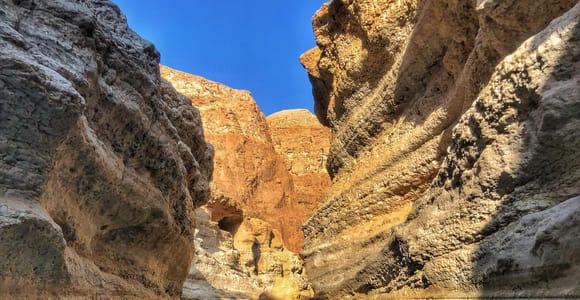
In Oman it counts, because of where the water goes. Rain on the Hajar mountains runs off bare rock into the wadis, and the wadis are what people have booked. A morning of rain inland can make Wadi Shab and the other gorge trips — 83 in our inventory from €11.62 — unsafe or simply closed, and a flash flood in a canyon is not a risk any operator negotiates with. It is uncommon. It is also concentrated in exactly the months that are otherwise the best time to come.
The practical consequence is not “avoid January”. It is: if a wadi day is the centrepiece of your trip, do not put it on the last day. Leave yourself one spare day to move it to.
In 2027, Ramadan sits in the middle of the good season
Ramadan is expected to run from 8 February to 9 March 2027, with Eid al-Fitr around 10 March. The dates are calculated in advance but confirmed by Oman’s moon-sighting committee shortly beforehand, so treat them as approximate until they are announced.
That places the entire month inside the best weather Oman has. It does not make it a bad time to travel, and Oman is a gentle place to be a visitor during Ramadan, but three things change:
- Eating, drinking and smoking in public during daylight is not done. Hotels serve guests, but a bottle of water on the Corniche at midday is a discourtesy rather than an offence.
- Opening hours shift. Shops, the souq and restaurants move their day towards the evening, and the evening is livelier than at any other time of year.
- Tours still run, but start times and the meals inside them move. If a trip includes lunch, ask what happens to it.
If you have no choice about the dates, come. If you do have a choice and you want the ordinary rhythm of the city, the second half of March 2027 onward is clear.
November to February: the peak, and the cold nobody packs for
This is the busiest stretch, with National Day on 18 November — the days actually taken off are announced each year and can shift — and the European Christmas and New Year weeks on top of it. Book the headline trips earlier than you would otherwise.
It is also, and this genuinely catches people, the part of the year when you need warm clothes. The coast averages 16.7 °C at night in January. Inland loses heat much faster than that: a night at a desert camp in the Sands needs a jacket, and the mountain days up to Jebel Akhdar — 72 trips from €21.09 — go above 2,000 metres, where it is a different climate from the one at your hotel. Nobody packs a fleece for Arabia. Pack a fleece.
If summer is the only time you can come
Then come, and reshape the day rather than the trip. The morning is the entire usable outdoor period: a boat at eight, back before the worst of it, and the afternoon indoors. That is not a compromise invented for the heat — it is how the dolphin trips, 23 of them from €27.75, are scheduled all year round anyway, because the sea is calmest at dawn.
Two things are actually better in summer. The water is warm enough that nobody thinks about a wetsuit, and the wadis, which are cold-water pools in shaded rock, stop being a bracing dip and become the best idea of the day. And the crowds are gone.
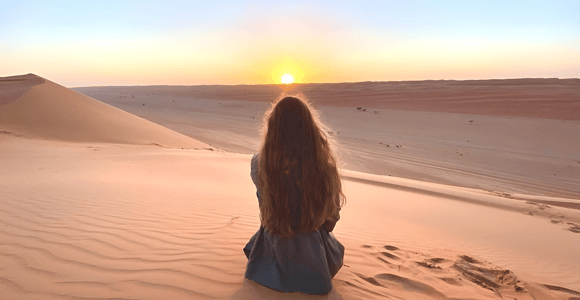
One thing is worse than the numbers suggest: the desert trips, 66 of them from €52.72, are a summer activity only in the last two hours of daylight. A dune at three in the afternoon in July is not a sightseeing destination.
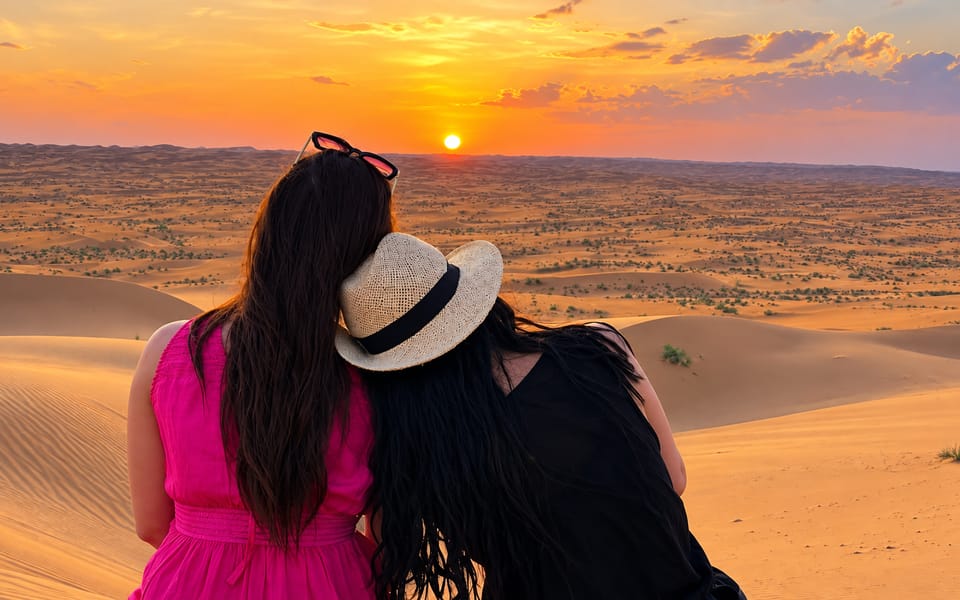
The listings that handle this well put the sand at the edges of the day and the middle of the day in water. Shared Wahiba Desert Tour with Wadi, Cave, Bedouin & Sunset — €86.99, 5 stars from 42 reviews, ten hours — takes in the dune drive, the Bedouin tent and the camel ride in the morning; Wadi Bani Khalid and the hike to Muqal Cave come afterwards, and that is where the hottest hours go, in the water and in the shade of the gorge, with lunch behind them. One note on the title: the sunset falls on the drive home, not on the dunes. If you want the dunes in evening light you need one of the trips with dinner at a desert camp — and they cost considerably more.